
Graceful Fulfilment
September 2024
Self-Care: not just for Facials and “Me Time”
Sign: Virgo – August 23 to September 22
Associated with: Service, discrimination, discernment, analysis, efficiency, perfectionism, conscientious, purity, fruitfulness, modest, pedantic, narrow-minded.
Colour: Navy blue, dark grey, brown, green, black, anything speckled and spotted.
Dosha: Vata (air)
Chakra: Third Eye (Ajna)
Body Parts: Abdomen, intestines, spleen, central nervous system.
I usually claim one afternoon a week (Sunday) for “me time”. I oil my hair, give myself a facial and pedicure, have a long hot shower (where I take care of all the things), and I usually spend at least an hour scrolling on my phone.
And while this time is important – It helps me feel ready for the week ahead and allows my brain to shut off for a while – there are a couple of things that bother me about the term itself and how it has changed from its original meaning.
Now, I want to preface by saying that I don’t think there is anything wrong with pampering ourselves or with finding moments of escape, especially in a world that continues to feel like it’s going off the rails.
However, for a term that first found its way into the populace in the 1950s as doctors tried to encourage their cancer patients to be proactive and take care of their physical and mental health, and then became synonymous with self defence and survival by black women in the Black Panther movement in the late 60s, it has been usurped by big corporations whose only wish is to capitalize on our sense of overwhelm and stress.
As a result, we have come to think of self-care as methods of escape rather than activities that ground us into self discovery, growth, and healing. The outcome today, and especially over the last four years, is that “self-care” has become a multi billion-dollar industry.
A quick Google search brings up articles in numerous publications showing stats about this growth, such as Statista.com reporting that, “The Beauty & Personal Care market worldwide is projected to generate a revenue of US$646.20bn in 2024.”
This same website reports that, “Despite the global recession, the beauty and personal care market in the United States continues to thrive with a strong focus on organic and natural products.”
Why does this set off alarm bells for me?
Because drinking a bottle of wine and getting a facial, manicure, or pedicure does nothing to build connection or community, calm the nervous system, allow the body and mind to truly rest, deal with past and current trauma, or create the mental and emotional space we need in order to build a thriving, nurturing, and supportive life for ourselves and the world around us.
In order to heal as individuals and as a collective I think it’s vitally important that we reclaim what self-care means. Self-care should, in my opinion, be an act of sacred self-compassion wherein we love ourselves enough to take time for inner reflection or self-study, listening to our bodies, cultivating connection and community, getting enough actual rest, and acquiring the mental and emotional the tools we need to heal our trauma.
These things can all feel overwhelming at first, like we’re just adding more work to our never-ending pile. And when we feel this overwhelm, when we allow ourselves to become aware that we need to practice these things, that’s when we usually decide we need the facial, or the fancy dinner, or the night out. Whether we are addicted to a substance or not, we are all addicted to escapism. It’s easier to “tune out” than to “tune in”.
Even yoga has become a tool of escapism. Affirmations spouting sentiments of “letting go of what no longer serves us” abound. But the heart of yoga has two things going for it:
- Asanas target specific energy centres in the body, and by moving and flowing through them, we open up channels of permission for trapped emotions and experiences to become noticeable to the conscious mind, and thus heal and change.
- Yoga is much more than just asana. The 8-limbs of Ashtanga yoga are a kind of road map designed to lead us home to our true selves. Along the way there are many points where we are invited to stop, breathe, and truly reflect on our beliefs, motivations, commitment, and tenacity.
The various practices within the eight limbs of yoga, such as dhyana (meditation), pranayama (breath), and asana (poses) are all tools we can add to our self-care toolbox. We can draw from its ancient wisdom when we need it and add this wisdom to a growing cupboard of tools we have gathered from friends, elders, creatives, knowledge keepers and professionals, spiritual gurus, other cultures, and even religions and belief structures. And the more we use them the more we become comfortable, and even grateful, for the opportunities they provide for self-reflection, growth, and healing.
So this month, when you schedule in your hair appointment or that afternoon wine and home spa day, I hope you also schedule in some time for one of the following yoga practice:
Yoga Nidra
Yoga Nidra is also known as yogic sleep. While meditation is in itself a very beneficial practice, Yoga Nidra has been shown to be more effective in calming the sympathetic nervous system (basically our flight-or-fight response), and activating the parasympathetic (relaxation and calm) nervous system. It has also been shown to act on the pineal gland which releases melatonin, a powerful antioxidant that helps manage immune function, blood pressure, cortisol levels, and induces restful sleep.
Click on the video below to enjoy a NEW MMY Yoga Nidra practice up on YouTube.
Asana Practice
Make more time for yoga! Be mindful and intentional with your practice. Use it to help you move through difficult emotions, or to clearly set intentions. Use it to be present in body, mind, and heart. If you’d like to join me on the mat, you can find this month’s Virgo Yoga Flow below. This practice focuses on the Third Eye, or Ajna Chakra. Tuning into our own, unique inner knowing, the inner wise woman/man, and the self that can take a step back and look at the whole picture, assess people and situations, and signal us when something is off or whether it’s worth paying more attention to.
Practice Svadhyaya (Self Study)
“Svadhyaya, which is the fourth of the five niyamas (personal practices) is learning about and developing the heart-mind (citta) by reading and listening to promote self-reflection, by reciting mantras, and by observing ourselves in action. Looking at ourselves insightfully brings us awareness of our strengths and shortcomings. Once we understand where we are, we can set an intention to let go of our negative qualities and reinforce those that have a positive effect. Svadhyaya includes understanding our physical, mental, and emotional bodies; our actions and impressions (karmas); and the world around us.”
Nicolai Bachman – The Path of the Yoga Sutras
Whatever you choose to do with the precious few moments you have to yourself in a day, I hope that it involves redefining your perception of self-care to mean mindful actions of self-compassion, self-love, and personal growth. I hope you love yourself enough to begin your journey toward sobriety from the addiction to escapism.
Much love,
Tamu


August 2024
Tap into the Power of your Core
Sign: Leo July 23 – August 22
Associated with: Leadership, endurance, confidence, pride, enthusiasm, attraction, courage, compassion, drive, playfulness, dramatic, opinionated, patronizing.
Colour: Orange, golden yellow, red, green
Dosha: Pitta (fire)
Chakra: Solar Plexus (Manipura)
Body Parts: Heart, spine, lower back
It’s Leo season, my friends! And that means that it’s time to trust in our abilities and move forward with confidence.
Leo has an innate self-confidence that radiates joy and seeks to lift others up. This is a Pitta (fire) sign that operates from the solar plexus, or the manipura chakra, meaning that when these people set their minds to something, they will follow through despite any obstacles the world decides to throw at them. As natural leaders (when they are in their wholeness) they seek to guide others with a gentle and protective heart. They are not here to compete as they are secure in their self-worth and the knowledge that we each carry our own unique gifts.
This month we are going to dive into these attributes and work to cultivate them with diet suggestions, asana practices, affirmations, and a breathing technique.
If that sounds like something you’d like to explore, read on!
The core is one of those areas of the body that is most neglected and yet the most vital to our overall well-being. When we engage the core with compassion, steadfastness, and a belief that we can cultivate long-term strength, we encourage these attributes in all other aspects of our lives.
For example, when we are mindful of what we eat and we feed our bodies healthy and nutritious food, we cultivate better gut health which can help with energy levels, sleep, mental health, and digestion.
Through cultivating a more connected relationship with our breath and engaging the lower lungs and the diaphragm, we help calm the nervous system, boost energy levels, and improve lung function and circulation.
And when we practice asanas or movements that engage the core, we help strengthen the entire torso, leading to better posture, improved stamina, and we can mitigate or alleviate lower back issues.
Diet
Let’s start off with diet. I am a major proponent of being mindful of what we put into our bodies and eating whole, locally sourced products as much as possible. (That’s not to say I don’t indulge. I need my chocolate, after all.) But knowing where my food comes from, being able to pronounce ingredients and understand what they are, and growing my own food as much as I am able have always been important to me. And over the last three years I have deepened this mindful approach and have noticed a marked difference in my overall health. I don’t deprive myself of foods (we all need a slice of pizza now and then), I just try to make conscious choices so my body can operate from a more optimal place.
So I thought I would share some simple rules that have not only helped improve my digestive health, but have also helped reduce bloating and heaviness, contributed to an increased sense of vitality, and improved the quality of my sleep. These “rules”, along with cultivating a more active lifestyle, have also contributed to the loss of 40 pounds over a two-year period.
- Reduce refined sugars. I use honey and maple syrup in my tea and coffee, as well as in baking, and I do my best not to purchase or consume products that contain white sugar, glucose, fructose, corn syrup and the like. This was a hard one for me as I have a major sweet tooth. My solution over the last few years has been to allow myself a couple of squares of my favorite dark chocolate after dinner and to let myself indulge occasionally instead of refraining all together.
- Reduce wheat products. Though I LOVE bread and baked goods, they don’t make me feel good. They immediately cause bloating and acid reflux, and they back up my system. Though I do indulge once-in-a-while, because I simply cannot resist ALL the time, I don’t consume bread and other baked goods on a regular basis. Pizza is maybe a twice a year thing. Burgers, the same. And when I bake at home for my family, I don’t overdo it so that I’m not left with an abundance of sweets in the fridge.
- Reduce red meat. I make sure to take in lots of protein, but again, red meat does not sit well in my stomach or digestive tract. This is something that varies for each individual. Some people really need red meat in their diet (depending on blood type), but I find that getting protein from chicken, tofu, tuna, beans, and nuts is easier on my body.
- Reduce dairy. I have switched to almond or oat milk for my tea, coffee, shakes, and baking. I’ll use milk on occasion, and I do eat cheese, I just keep it to a minimum. And I have found that ice-cream is a killer. Again, this is individual, but finding alternatives helps with my overall health and well-being.
- Eat more fruits and vegetables! I have a salad almost every day. My gut health suffers when I don’t have greens and a variety of veggies in my diet. And when I grow my own or source locally, I know that these veggies are giving me more of the vitamins and minerals my body needs, and they are not riddled with herbicides and pesticides. I also make sure to put a variety of frozen fruits in my protein shake every morning.
Again, these are just tips and tricks that I have learned over the last few years that have helped my gut, as well as my overall health. Taking into consideration your personal nutritional requirements, I invite you to see what happens if you choose to follow one (or all) of the above for one month and see how you feel.
*I am not a nutritionist, and this is not medical advice. Please consult your doctor to determine what is right for you.
Asana
Whether or not you decide to change-up your diet, developing core strength is something we can all benefit from. One key factor when embarking on this journey is to think long term. Nothing happens overnight, nor should we expect it to. The body needs time to adapt, and we need to give the mind time to develop new pathways that allow for a change in routine. If we push ourselves too hard at the beginning, we just set ourselves up for disappointment. Start with baby steps, incorporating a couple of asanas at a time into your regular practice. I have worked out at least 4 days a week, on top of practicing yoga pretty much daily, for the last 3 years and my core is still the most difficult and challenging part of my body to strengthen and feel confident with.
That being said, a little core each day goes a long way. And though I deal with chronic lower back pain due to arthritis and a bulging vertebrae, I know that if I did not keep active and strengthen my core that I would be in much worse shape and that it would only get worse as I get older.
So this month, I have three asanas for you:
Yogi Bicycles (Dvichakravahanasana Criss Cross Pada Flow)

Benefits:
This dynamic core movement strengthens abs, deep core, and obliques. It also targets quads and hip creases, upper back and shoulders. Because there is a bit of a twist involved, this flow also stimulates the digestive system.
How to:
Come to your back and bend your knees, lifting them above your hips. Interlace your fingertips behind your head, with elbows wide. Hug your navel to your spine and push your lower back into the earth, tucking the ribcage down. Breathe in, and on an exhale lift head, neck and shoulders and send your right leg out to hover at the bottom of your mat while you bring your right elbow toward your left knee. Alternate to the other side, working to keep in time with your breath. Do a flow of at least 10 (5 on each side) and work up from there.
Revolved Chair Pose (Parivrtta Uttanasana)

Benefits:
This pose is a whole-body strengthener. It engages the spinal chain, upper and mid back, and the lats while it opens the chest and shoulders encouraging better posture, stamina, stability and balance. It also engages and strengthens quads, hamstrings, calves and glutes. This is a powerful pose that invites focus and determination.
How To:
Come to a standing position with feet as together as works in your anatomy. Toes pointing forward, and glutes, quads and core engaged. Elongate through the spine, reaching the crown towards the sky. Reach fingertips up, extending through your arms. Try to bring your biceps beside your ears. Notice the length of your spine and try to maintain this length as you bend your knees and send your hips back, like you are going to sit down on a chair. Lower down until your quads/thighs are completely engaged. Work to transfer your weight to your heels and bring your knees over your ankles. Next, keeping the right arm extended past the crown, or out in front of you, reach the left fingertips back, thumb up. Pull back with the left shoulder. Hold for three to five breaths, then repeat on the other side.
Boat Pose (Navasana)

Benefits:
Navasana strengthens abdomen, pelvic floor, quads, hip flexors, glutes and pelvis. It improves balance and posture, helps to focus the mind, and improves digestive health. This is a great pose to practice when you have a busy mind, or when you are having trouble completing tasks and need to focus your attention.
How to:
Come to a seat with knees bent and heels to the floor, bringing them about hip width distance apart. Scooch your butt forward until you feel your sits bones make direct contact with the floor. Bring your hands to the backs of your thighs and sit up tall, rolling your shoulders away from your ears. Lean back until you feel your core fully engage. To expand, reach your fingertips past your knees, palms face up. Keep the chest lifted. Stay here for three to five breaths. Expand by lifting your feet until your shins are in line with your outstretched palms. To fully engage the thighs, try straightening the knees and reaching the toes up to the sky.
Whether you integrate these poses into your regular yoga practice or workout routine, or you just practice them on their own a couple times a week, be sure to rest in between, and remember to start small and slowly challenge yourself as you progress. Think of the long-term results you want to see as well as your emotional or energetic reasons for utilizing these asanas (whether you need to calm the mind, boost your self-esteem, or cultivate focus). Move mindfully and with intention, but allow yourself to have fun, to experiment, to enjoy engaging your body in new and challenging ways.
Affirmations
Repeating affirmations before, during, or after practicing the above asanas will help you adjust your mindset, gain focus, boost your self-esteem and your belief in yourself, and provide you access to your inner Leo. The fearless lion-heart that resides in your manipura chakra; the confident, fearless part of you that can conquer anything you set your mind to.
These affirmations are just suggestions. You can change them, make up your own, or Google other Leo related affirmations. What matters is how you speak to yourself. The mind believes what we tell it, while our true Self is boundless and forever capable, not trapped by the constraints of societal and personal beliefs.
Here you go:
“I lead with confidence and compassion”
“I spread joy and lift others up”
“I believe in my ability to achieve my goals and dreams”
Breath
Benefits:
Finally, we have the breath. A deepened breath practice is not just about providing the body with more oxygen and helping to calm the nervous system. The diaphragm is a major muscle of the core that drops down into the abdomen to expand and draw oxygen deeper into the lungs. When we strengthen and learn to utilize the diaphragm, we do all of the above with more efficiency while helping to improve circulation and mental focus. And when we strengthen the core muscles we improve our exhalation which stimulates all of the major organs and improves digestion.
For this reason, we will focus on Kapalabhati. This is the breath of fire, or skull shining breath. Kapalabhati requires core engagement and concentration. It clears the mind and ignites agni, or fire, in the belly.
I recommend starting slow with this breath and focusing on the engagement of your core above how many breaths you take, or how fast the breaths are. Don’t be afraid to slow it down at first and, as always, listen to your body. If you begin to feel light-headed, stop.
How to:
Find a comfortable seat of your choice. Sit up tall, lengthening through your spine and the back of your neck. Lift your sternum and roll your shoulders away from your ears. Bring your hands to your belly, right hand on top of the left.
Take a deep inhale and relax your belly. Let it balloon outward and become soft. Exhale sharply, drawing the belly button back toward the spine and up toward the ribcage. Play with this a few times, always allowing the belly to soften and expand on the inhales and engage and draw inwards and upwards on the exhales. In this way, the diaphragm is doing most of the work of drawing oxygen into the lungs. Notice that your ribs do not lift and expand outwards as much. When you feel ready, try taking 10 rhythmic and intentional breaths.
Traditionally it is taught that we breath in and out through the nose in Kapalabhati, but I tend to breath through my mouth simply because my nose like to run and I find flying snot to be very distracting.
There you have it, folks! Your little guide on how to boost your self-esteem and tune into your personal power and strength through honouring these aspects of Leo.
I hope you find these practices useful, and if you’d like to share your experience. Please feel free to comment below.
And if you’d like to join me for a Leo inspired yoga flow, click on the video below.
I’ll see you on the mat!
Much love,
Tamu
July 2024
Dive into the wisdom of the Third Eye
Sign: Cancer June 21 – July 22
Associated with: Nurturing, emotions, sympathy, vulnerability, defensiveness, tenacity, ambition, moodiness, protectiveness, intuitive, sentimentality.
Colour: White, smoky greys, green, russet, iridescence
Dosha: Pitta (fire), Kapha (water)
Chakra: Third Eye (Ajna)
Body Parts: Breasts, nipples, lymphatic system, female reproductive organs, alimentary canal.
Ah, Cancer season. The sun is shining, gardens are in full swing, people are spending time with family and friends around the BBQ, and we are all making any and every excuse to be in any body of water we can access.
Cancers are beings that like to stay within the protective cover of their shells; being a homebody, nurturing family and close friends, and focusing on their creative endeavours. They are charmers, welcoming you with their wide, pool-like eyes. However, this sign doesn’t let you in easily as they are protective of their vulnerable hearts.
But if you have a Cancer in your life, you will also know that they are deeply intuitive. They often know what you are feeling before you do, and their advice is often spot on.
So this month we will focus on developing, or tuning into, our own innate intuitive capabilities. This centre of knowing sits in our third eye (ajna chakra).
Now, we’ve all heard the expression “trust your gut” when it comes to intuition, so I invite you to imagine intuitive knowing as a pool bathed in the light of the moon. The moon is your third eye, and the pool is your gut. The knowing of the moon reflects itself in the waters of the pool, hence, when we have a gut feeling about someone or something, when we just “know” that we need to move in a certain direction, when we have flashes of creative insight or feel inspired, or when we can “foretell” that something is going to happen, our gut is picking up on what our third eye is intuiting.
For many of us, discerning between the busy/anxious/overactive mind (citta) and our intuition can be a tricky thing. That’s because this inner knowing is like a subtle tap on the shoulder; the small voice that resides underneath the constant chatter of the mind. Because we are not taught to listen to this small voice and are instead taught to be “logical” and believe that the Self resides in the mind, or the ego (how we perceive ourselves to be) it can take practice to learn to hear, and trust, this still, small voice. And one of the key practices that can help us hear the small voice of intuition is to learn to listen to the body, especially the gut.
Below you will find three asanas that help to activate the third eye chakra, but before we get to that I invite you to combine them with these energetic practices. And remember to take it slow, take baby steps, and always trust the feeling you have in your belly, that vulnerable spot right below the rib cage.
- The next time you are out in nature, take some time to just wander. Instead of having an agenda or telling yourself you are going to walk that path/route that you always walk, just follow your feet. Pay attention to the little things: a flower, a slant of light, the call of a bird, the flight of a bumblebee. Notice what happens with your thought process as you do this. Notice how the nervous system calms. And pay particular attention to little bits of knowing or understanding that bubble to the surface. Notice where you end up, where you feel called to sit for a moment, and all the little synchronistic signs the universe is sending your way.
- Keep a journal beside your bed and when you wake write down little bits of your dreamtime that stand out to you. Dreams are the landscape of the subconscious and, no matter what, they are always teaching us something. They are helping us to work through problems or issues that the conscious mind doesn’t have the answers to. This is the third eye at work. Reflect on your notes throughout your day. What little hints was the dreamtime trying to give you about your daily life? For instance, before I left Salt Spring, I dreamed for about a year about being on the ferry to leave the island, but I never reached my destination. I would always end up either in the water or on some other island, but never where I wanted to go. My dreamtime was telling me “You feel trapped and you see no escape”. When we finally moved to Vancouver Island, the dreams stopped.
- This one is a little harder. I invite you to experiment with trusting your gut. Every time you engage with someone, whether you know them or not, take a little moment to acknowledge how your gut feels. Do you feel excited? Do you feel worried? Do you feel fear? Do you feel calm? Do you feel safe? What is your first instinct, the one you usually ignore because the logical mind tells you to stop that nonsense? After you have made note of this feeling, regardless of how you decide to act in the moment, watch what happens with that relationship or interaction. Did that person prove themselves to be safe? Did they let you down? Did they deceive you in some way? And then think back to the way your gut felt. I’m willing to bet that it was right and you’ll more than likely be kicking yourself for not listening to what it (and your third eye intuition) was trying to tell you.
Ok, now that we have the energetic practices established, let’s move on to a few asanas that can help you activate your third eye chakra. You can practice these on their own, or you can hop on over to my YouTube channel and move through your Cancer Yoga Flow for this month.
- Standing Splitz (Urdhva Prasarita Eka Padasana)
This is an asana that requires focus. Being a balancing practice, it forces you out of your mind and into your body. But because the third eye is brought toward the shin or knee, it also pools our awareness into that centre while the head being below the heart allows for better blood flow to the brain.
How to:
Bring yourself to tadasana (standing). Lengthen through the spine and fold forward. Bring your hands or fingertips to the ground (or to blocks), making sure they are about 6 inches in front of your feet for stability. Bring your weight to your right leg, grounding through your foot and bringing a soft bend in the right knee. Try not to lock it. Then lift your left leg as high as you can. Try to keep your hips square or level. Take at least three deep breaths before bringing the left foot back down to meet the right. Lift up to tadasana and shake it off before moving to the second side. - Crescent Lunge (Anjaneyasana variation)
In this variation we bring the tips of the fingers together and bring our gaze up to the palms. While this is a stretch for the hamstrings, hips, and hip creases, it also brings our awareness to the third eye through the act of looking up. Here we can access that bridge that the third eye allows between the “I” consciousness and “super consciousness”, or the Atman: our higher self.
How to:
From Downward Dog or Table (all fours) step your right foot up between the palms. Wiggle the front foot foreward until you can see the whole thing, creating a 90 degree angle in the knee and establishing a strong foundation. Allow the hips to drop down and forward while keeping the right leg engaged and right foot pressing into the mat. When ready, reach the arms up and back, backing off in the hips if need be before settling them back down and forward. When you feel stable, bring the fingertips together and lift the gaze skyward, letting it land on your hands. Stay here for three to five breaths before bringing the hands back down to the mat and adjusting to the other side. - Bridge Pose (Setubandha Sarvangasana)
While this is a glute, hamstring, and spinal strengthener, it promotes connection with the innermost self and our intuition. It is also a perfect beginner pose for those who are working toward shoulder stand or plow pose which are also third eye activators.
How to:
Come to your back and bend your knees, bringing the soles of the fee to the ground. Hike the heels back toward the sits bones and make sure the feet are about hip width distance apart. You don’t want them flush together, and you don’t want them wider than your hips. Roll your shoulders away from your ears creating an open chest and a grounding of the shoulders into the mat. Create space between the chin and the chest, taking the gaze straight up and back so your breath does not become restricted. Reach the fingertips down toward the heels, palms face down. When you are ready, inhale and lift the hips up toward the ceiling, engaging the glutes and the hamstrings. Once there, you can interlace the fingertips and press the arms down into the mat. Stay for three to five breaths before slowly lowering down.
These are just three asanas that help to stimulate the third eye chakra, but when practiced regularly, and with the focus being brought to this energy center using the breath, they can help us strengthen our connection to our intuition and inner knowing.
As you experiment with the above practices, whether energetic or physical, remember that this is all about learning to trust yourself. You have innate knowing that is there to serve you and your highest good whenever you need it. All it takes is commitment and practice to hone and ground into.
I wish you all the best on your journey into the wisdom of the third eye, and hope these practices serve you well.
Much love,
Tamu
June 2024
Gemini Season: Duality, communication, curiosity
Sign: Gemini May 21 – June 20
Associated with: Communication, multi-faceted, adaptable, duality, versatile, inquisitive, social, superficial, cunning, witty, capricious, restless
Colour: Yellow, black, white with red spots
Dosha: Vata (air and space)
Chakra: Throat (Vishuddha)
Body Parts: Nervous and respiratory systems, hands and arms, thymus
Gemini is the sign of duality, communication and curiosity. Ruled by Mercury, this sign is mutable and multifaceted. They pick up new information quickly, can bounce between topics with ease, and are always up for a good debate.
But being a vata dosha, they can be nervous and suffer from anxiety, making them flighty and unreliable. They’re also known for being that person that will switch from hot to cold without warning.
As such they can use help grounding and they often need a reminder to be compassionate with themselves and others, to honour the duality (the dark and the light) in everyone and everything.
Whether or not you have Gemini in your chart, chances are that you are feeling one or more aspect of the above. If so, here are three yoga asanas that will help you balance, ground, and honour and move through any uncomfortable feelings that may be surfacing.
Revolved Wide Leg Forward Fold
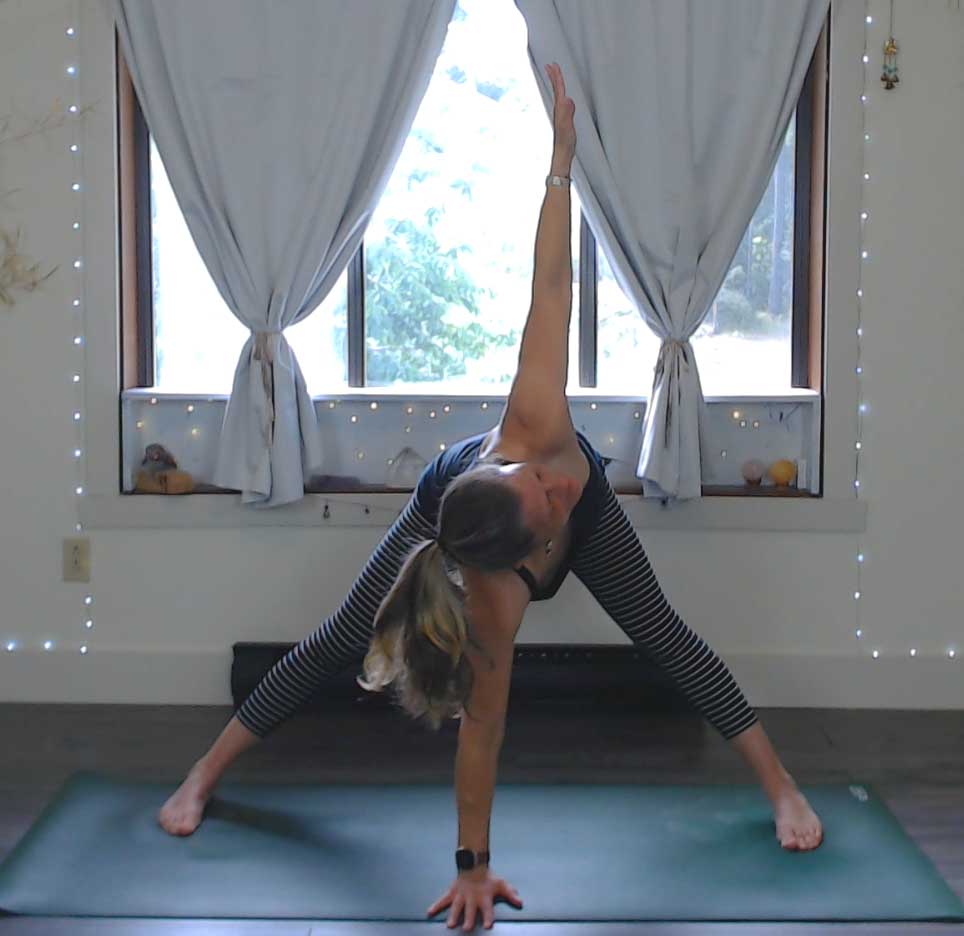
The first is Revolved Wide Leg Forward Fold, or Parivrtta Prasarita Padottanasana
This pose is wonderful because it connects us to both our third eye and our root, bringing a balance between intuition and foundation. It’s also a great spinal twist, helps with flexibility, and is a beautiful indicator for what is happening on both sides of the body.
How to:
Bring your feet wider than your hips (at least 3′ apart), toes pointing forward. Lengthen your spine by reaching to the ceiling and then fold forward. Bring hands to the floor or to blocks. Feel free to adjust your feet and feel into the pose before revolving. To revolve, place your left hand on the floor under your shoulder and reach the right fingertips up to the sky. Pull back with your right shoulder and open your heart. Repeat on other side.
Humble Warrior


Next we have Humble Warrior or Baddha Virabhadrasana
This powerful posture invites us to marry courage with humility, to remember that we are but a single story in the fabric of the universe. While strengthening quads and hamstrings, opening the chest and shoulders, and engaging the core, this pose brings into alignment the throat, sacrum, and root. Thus, how we communicate with the world is rooted in creativity and compassion.
How To:
Begin standing. Step your left foot back and dial your left toes in to a 45 degree angle. Right knee is bet, with the knee stacked over the ankle. Reach your fingertips up to the sky and open your chest and shoulders. Keep the torso lifted as you exhale and interlace your fingertips behind your back. Keep your shoulders rolled away from your ears as you bow forward to the inside of your right thigh. Only bow forward as much as feels comfortable in your body. Stay grounded in your feet. Stay for 3 to 5 breaths and come up. Repeat on the other side.
Yogic Squat


Finally we have the Yogic Squat, or Malasana
This pose is all about the first two chakras. It brings connection to the Earth, to humanity and to our ancestors, and to the foundation of our beings. A deep hip opener, this pose also strengthens and lengthens the spine, promotes good posture, and stabilizes ankles and core.
How To:
If you have knee issues, use a block or low stool for this pose, and approach with mindfulness.
Bring yourself to a standing position and bring your feet just wider than the hips. Rotate toes out and heels in. Fold forward and bring your fingertips to the earth. When you are ready, bend the knees and lower your sits bones toward the earth. If you are using blocks or a stool, rest your weight on the prop. Bring your elbows to the inside of your knees and your palms together. Press knees into elbows, and elbows into knees. Lift your chest and lengthen through the back of your neck. Stay for 3 to 5 breaths before planting he palms and lifting your hips back to a forward fold position.
Affirmations
While moving through these asanas, try these three affirmations to help focus your mind, calm your nervous system, and provide yourself with grace and love.
- I accept the duality of myself and work to bring all aspects into balance.
- I move through thoughts and ideas with ease, while staying grounded in the everyday.
- I remind myself to have patience and compassion for myself and others.
I hope you enjoyed this exploration and that these asanas help you ground any flighty Gemini energy. And if you’d like, you can hop on your mat to join me for June’s Gemini Yoga Flow over on YouTube.
Much love,
Tamu
May 2024
Yoga for Grounded Self-Expression
Sign: Taurus April 20 – May 20
Associated with: Endurance, materialism, steadfastness, productivity, self-indulgence, practicality, security, sensuality, patience.
Colour: Green, pink, pale blue, lemon white
Dosha: Kapha (earth)
Chakra: Throat (Vishuddha)
Body Parts: Throat, neck, thyroid gland, vocal cords, and ears
Here are three practices to cleans your throat chakra (and remember your inner badass).
From your friendly cosmic bull – Taurus.
You’ll know a Taurus when you see one because they aren’t impressed by much. Drama and uncertainty aren’t their thing. These people are stable, self-assured, determined, and practical. They love the luxuries of life and have no problem spoiling themselves. They are patient and will put in the time required to see long-term goals come to fruition. And they are not afraid to express their opinions, boundaries, and personal truth.
I don’t know abut you, but being a Pisces I can learn a lot from our Taurus friends. Because Taurus sits physically and energetically in the throat (vishuddha) chakra, tuning into the gifts of this sign can teach us about expressing who we are in a grounded and unapologetic manner, which isn’t always easy. Many of us are blocked in this energetic centre because we have been taught by society to stay small, keep our opinions to ourselves, and only do what is acceptable to the world around us. Therefore, cleansing this area and freeing ourselves from this energetic rubble can be an empowering act.
If you would like to learn how to clear your throat chakra, I offer you a few yoga inspired techniques that are designed to help you embrace your inner calm, cool, collected, and badass self.
Cleansing the Throat (Vishuddha) Chakra
The throat chakra is literally the gateway between the mind and the heart. It is the place where the information from our third eye (ajna) – that place of intuition and inner knowing – and our heart (anahata) – centre of unconditional love – come together to be expressed as our innermost truth (satya).
When the throat chakra is in its wholeness, we are able to express who we are, what we believe, and what we desire from a place of equilibrium and integrity; we have no trouble setting boundaries and being clear about what works for us and what doesn’t; and we are not afraid to let our creative self shine for the world to see.
When this energy centre is overactive expression can be overbearing, rambling and unfocussed, and even chaotic.
When the throat chakra has shut down it shows up as a lack of self-esteem, an inability to set boundaries, and a timid and fearful demeanour.
The throat chakra is susceptible to tension and constriction due to stress, anxiety, and mental clutter, as well as a closed heart centre due to isolation and disconnect. Physiologically this area is linked to the immune system through clusters of lymph nodes in the tongue, jaw, pharynx, oesophagus, and trachea. This means that the throat is both vulnerable to infection and powerful line of defence for the entire body.
Therefore, practices that promote relaxation of the throat, jaw, tongue, and neck work to reduce tension and promote lymph flow which detoxifies the body and boosts the immune system while also clearing the energetic pathways between the heart and the third eye. In Sanskrit, this cleanliness, or cleansing, is called soucha. Soucha is the first of the niyamas and is seen as a self-practice that is vital on the path to transformation.
Hatha Yoga Pradipika:
Neti (nasal rinse) cleanses the cranium
And bestows clairvoyance.
It also destroys all diseases
Which manifest above the throat
We won’t go into Neti (nasal cleansing) in this article, but we will look to breathwork, asana, and mantra, for some throat cleansing tips.
Breath
Ujjayi Breath (Ocean Breath)
Ujjayi breath is one of the most accessible pranayama practices, so it is great for beginners and those who are just starting to explore.
Physically this pranayama helps to reduce infections and allergies, addresses asthma related issues, it strengthens the diaphragm, and is effective in reducing the accumulation of phlegm.
Energetically this breath helps to clear the entire sushumna, the channel along the spine that runs from the root (muladhara) chakra, all the way to the third eye (ajna). With conscious awareness, the practitioner moves the breath up through the chakras with each inhalation, and in a downward motion with each exhalation. This action balances the endocrine system and addresses thyroid conditions and pulmonary functions.
How to:
Ujjayi is practiced by bringing a soft restriction to the vocal cords (or back of the throat) on both the inhale and the exhale. This restriction slows the breath down, creates focus, and brings awareness to the senses. This breath is practiced by breathing through the nose, but one way to assess if you’re doing it right is to exhale with an open mouth and pretend that you are fogging up a window. The breath should sound similar to holding a conch shell to your ear and hearing the ocean.
Asana
Shoulderstand (Salamba Sarvangasana)
Shoulderstand is known as the “Mother of all Poses” because it supports drainage of blood and lymph out of the legs, gut, and chest and replenishes the nasopharynx, thyroid and parathyroid glands, lymph nodes, and tongue.
How to:
It is important in shoulderstand to make sure that the shoulders are supported and that there is not undue restriction put on the throat or the neck. It is recommended that you place a folded blanket under your shoulders and allow the head to rest on the floor below their height.
Come to your back, knees bent, shoulders on blankets and head reclined on your mat. Bring your knees into your chest and using your core, lift your hips up off the earth. Catch your hips/lower back with your palms, elbows resting on the floor. Once you feel stable, try to decrease tension in your throat and lengthen your spine up toward the ceiling, lifting your hips as far as you can. If you feel safe, work to straighten the knees and lift the feet toward the sky. Try to keep the throat and shoulders relaxed, with as much space as possible between the chin and the chest.
If this version is not accessible, or your breathing becomes too restricted, you can shimmy your sits bones as close as possible to a wall and use your leg strength (feet against the wall, knees bent at 90 degrees) to help you lift your hips. Palms stay face down on the floor with fingertips reaching toward the wall.
Mantra
Ham Mantra
Last, but not least, we will focus on sound. In yoga, the use of mantra is seen as a way to connect to divinity, to the vibrations of the universe. Each chakra has its own sound that represents a resident flower. From root to crown, each flower becomes more elaborate and by intoning the sound for the chakras the “flower essence” blooms.
The sound of the throat chakra is “ham”. This sound represents the cosmic swan, hamsa, who is believed to be able to travel our earthly waters and soar into the celestial sky.
This practice eases and relaxes the throat and illuminates this energetic centre allowing its blue petals to unfurl.
How to:
Sit in a comfortable seat and elongate through your spine. Relax the jaw and allow the tongue to rest behind your lower teeth. Soften the skin of the face and neck, allowing the throat to open and widen. Imagine the blue flower of the throat chakra sitting open in all directions at the base of your jaw, with the stem of the flower reaching down through your trachea. Allow your breath to become soft and smooth.
When you are ready, breathe in through your nose and on your exhale chant the mantra Ham. Keep the back of the throat as open as possible, with the a sound long (Haaam). See if you can practice this for 2 to 5 minutes.
If you would like, you can incorporate the vishuddha mudra which is done by interlacing your fingers and bringing the palms together. Now connect the thumb and forefinger of each hand. Bring the hands in this formation up to your throat centre while you chant.
I hope these practices help you feel more grounded in your ability to express yourself and bring you a sense of peace and ease.
Much love,
Tamu
April 2024
Yoga for Growth and Change
Sign: Aries March 21 – April 19
Associated with: Courage, determination, confidence, enthusiasm, optimism, honesty, impatience, impulsiveness
Colour: Red, white
Dosha: Pitta (fire)
Chakra: Solar Plexus (Manipura)
Body Parts: Head and face, adrenal and suprarenal glands
Spring has finally sprung! And though winter seems to be clinging on as much as it can, at least we are experiencing warmer temperatures and nature coming to life all around us. It’s no wonder that the fiery, go-get-it, determined, and enthusiastic sign of Aries is the astrological sign for this time of year. Like the dandelions pushing up on your lawn and in your garden beds, Aries energy fills us with drive and optimism for the future. We feel inspired to get busy, to make lists, to plan activities and projects, and generally be productive.
This means that this is a great time of year to get clear about what we want and lay foundations for long-term goals. Like the Ram, we can put our heads down and move forward with little to no distraction and confidence in our path and purpose, even when things get hard.
But the energetic and industrious ram often charges full-steam ahead and forgets about the needs of the body, mind, and heart which can lead to imbalance, burnout, and even dis-ease. So if you are feeling tired, lethargic, stressed, or like it’s simply not as easy as you would like to get on board with this spring energy, I would like to offer you some tools you can add to your energetic and physical wellbeing toolbox so that you can embrace change and growth with strength, ease, and courage.
To do so, we are going to dive deeper into the doshas, the three fundamental regulatory principles of the body: vata, pitta, and kapha.
We can think of the doshas as the elements of the body, and like the natural world around us, these elements are all connected and dependant on each other. So, while we may be born with one element being more prominent than the others, each one can become out of balance at different times in our lives.
Learning which dosha is out of balance not only helps the body find its way back to equilibrium, but it also helps regulate the nervous system through a deeper understanding and awareness of the signals our bodies are sending us. This self awareness creates a more trusting relationship between body and mind, mind and intuition (gut feeling), and our ego (personality self) and our sense of source.
When we give the body time and space, along with tools/resources it needs to heal, we create more confidence in ourselves and our abilities. We can embrace change, face challenges, and move forward with curiosity and an open heart and mind.
So if this Aries energy has you filled with a million ideas and charging in a million directions, but there is also part of you that is exhausted, overwhelmed, or struggling with health issues that you have taught yourself to ignore, I invite you to join me for a two-week commitment to health and healing.
All you have to do is figure out which dosha is out of whack (info below), follow the basic dietary guidelines for balancing out that dosha, and practice the mudras and yoga asanas suggested. I recommend cultivating a daily meditation and movement practice to establish consistency and to support the journey of trust you are creating between your body, mind, and innermost self. At the end of the two weeks, you should notice a return to energy, confidence, and the courage and enthusiasm you need to move forward with your dreams and intentions.
*Please note that these dietary suggestions are no substitute for medical care. Always consult with a doctor about any health concerns you may have.
Doshas
Vata (Air and Space)
Dry, moving, cold, light, changeable, subtle, rough, quick
Vata, or the winds of the body, sits in the colon and is connected to the nervous system. This dosha affects every part of the body as well as the other two doshas, therefore when Vata is brought back into balance, it brings Pitta and Kapha along with it. Vata people are quick thinkers and learners, have great imaginations but poor long-term memory, are sensitive, spontaneous, resilient, and exhilarated. They often feel restless and are prone to mood swings and racing thoughts.
When Vata is out of balance we can experience things like worry, anxiety, overactive mind, insomnia, asthma and other respiratory complaints, dry cough, dry or chapped skin and lips, sore throat, generalized fatigue, high blood pressure, slow digestion, gas, diarrhoea, nervous stomach, constipation, intestinal cramps, lower back pain, poor circulation, irregular heart rhythm, and stress related nervous disorders such as depression, short attention span, impatience, and an overactive mind.
To bring Vata back into valance, it is important to cultivate regular habits, find quiet/practice meditation, drink lots of fluids, get ample rest, avoid mental strain and overstimulation, keep warm, get plenty of light and surround ourselves with cheerful colours, provide the body with a steady supply of nourishment, and even invest in deep tissue massage.
When it comes to foods that help pacify the Vata dosha, here are the basic guidelines:
- Add soothing foods such as milk, cream, butter, warm soups, and long-cooked stews and hot cereals.
- Eat a nourishing, substantial breakfast. Anything warm, nourishing and sweet.
- Eating regularly is essential, so besides making sure you are getting three meals a day, consider a warm snack between lunch and dinner, including a nice hot cup of herbal tea.
- Eat warm, moist foods such as cooked grains and cereals and flavour with ginger, cinnamon, fennel, and cardamum.
- Sweet foods are comforting to Vata, but try to use natural sweeteners such as honey or organic maple syrup. Sweet fruits such as green grapes and mangoes are an excellent choice.
- Cook your vegetables and if you are partial to salads, let them come to room temperature and choose and oil and vinegar dressing.
- In terms of protein, avoid red meat and favour chicken, seafood, turkey, or beans.
- Avoid brassicas, leafy greens, potatoes, mushrooms, and peppers and favour beets, carrots, asparagus, green beans, okra, onions, and yams.
- Most well-ripened fruit is good for this dosha, but avoid apples, cranberries, pears and pomegranates.
- Favour oats, rice, and wheat over other grains.
Asanas that balance out Vata:
Because Vata is cool, dry, and quick, we want to calm those aspects by grounding, creating heat and lubricating joints. It’s important to move slowly, hold poses for longer, and bring awareness to deepening and lengthening the breath.
